The Lights Stay On. EU × UNDP: Exhibition Case Study
The Lights Stay On. EU × UNDP: Exhibition Case Study
The Lights Stay On is a documentary photo exhibition commissioned by the European Union (EU) and the United Nations Development Programme (UNDP) to highlight the resilience of the Ukrainian people and the impact of Ukrainian partnership with the EU and UNDP.
The Lights Stay On is a documentary photo exhibition commissioned by the European Union (EU) and the United Nations Development Programme (UNDP) to highlight the resilience of the Ukrainian people and the impact of Ukrainian partnership with the EU and UNDP.
date
2025
2025
photos
Danylo Antoniuk, Ivan Antypenko, Kostiantyn Chernichkin, Oleksandr Himanov, Kateryna Klochko, Halyna Kuchmanych, Danylo Pavlov, Valentyna Polishchuk, Viacheslav Ratynskyi, Maryna Romanenko, Dmytro Smolenko / Reporters / UNDP in Ukraine
Danylo Antoniuk, Ivan Antypenko, Kostiantyn Chernichkin, Oleksandr Himanov, Kateryna Klochko, Halyna Kuchmanych, Danylo Pavlov, Valentyna Polishchuk, Viacheslav Ratynskyi, Maryna Romanenko, Dmytro Smolenko / Reporters / UNDP in Ukraine
Intro
The Lights Stay On is a documentary photo exhibition commissioned by United Nations Development Programme (UNDP) and the European Union (EU) to highlight the resilience of the Ukrainian people and the impact of Ukrainian partnership with the EU and UNDP.”
Context
During Russia's full-scale invasion of Ukraine, the UNDP and the EU launched multiple development and recovery programs supporting Ukrainian communities.
The continuation of these development programs mostly depends on continued support from EU policymakers and stakeholders.
For this reason exhibitions and other mediums are often used to foster continued support.
The task
Our foremost task was to foster this continued support by presenting tangible results of the Ukrainian - European partnership, in the form of a documentary style photo exhibition (within the European parliament) presenting the stories of Ukrainian individuals that were most affected by the different UNDP and EU programmes.
Secondarily we were tasked with presenting this exhibition as a digital campaign at Brussels Airport, to maintain support among the European tax payer.
Preliminary research
To understand our goal and challenges more clearly we started our process with interviewing EU officials and diplomatic workers about their exhibition experiences.
Two responses stood out:
“It’s hard to see suffering every day, it creates a feeling of powerlessness — even though we are building support programs constantly.”, - Respondant A
“I understand the importance of documentary evidence, but I wouldn’t bring my children to these exhibitions. Even I find them hard to look at, often I walk away.”, - Respondant B
Showing that similar exhibitions mostly rely on the same strategy: using images of human suffering to provoke empathy, and that this strategy has its downsides.
This repeated exposure to traumatic imagery leads to compassion fatigue — a natural coping mechanism. Instead of mobilising action, such exhibitions risk creating distance, numbness, or avoidance.
Challenge
Having done our research we voiced the following challenges:
EU officials, diplomats, and policy builders are exposed to global tragedies daily. To reach them effectively we cannot rely on provoking empathy from suffering.
Our audience is multicultural, and likely has minimal knowledge about Ukraine or its culture.
Our audience is busy and has limited time and attention.
The exhibition shares space with many competing political and humanitarian narratives and should stand out.
The key question
How do you create a real emotional connection and inspire continued support without overwhelming the viewer and triggering compassion fatigue?
Our Answer
Emotional connection doesn’t only come from pain. Pride, hope, recognition, and connection can be more powerful and more sustainable motivators than shock. Showing what European support already makes possible is more effective than repeating images of loss.
Our Approach
Part 1: Representing Pride through Stories
To invoke the feelings of pride of what was already accomplished, we
curated stories from the UNDP’s extensive interview archive in the following way:
Reviewed all relevant reports and program documentation, to represent the background accurately.
Selected those stories that:
Demonstrated the significant impact of EU-UNDP programs.
Demonstrated the resilience, gratitude and heroism of the Ukrainian hero’s.
Show the human faces that these policies affect.
Edited the report style interviews into short stories that:
Where easy to read and to the point.
Highlighted the incredible results of the programme.
Simplified cultural references.
Simplified geographic references by adding clear infographics showing each hero’s location, helping visitors situate stories spatially within Ukraine
Part 2: Connecting Cultures through Visuals
To strengthen the exhibition's cultural connection, we looked for European symbolism that our audience in Brussels would recognise and feel connected to, using it to help tell the Ukrainian story with an aesthetic they know.
Finding this cultural connection was the most difficult part of this project. So we once again turned to research. While searching for an aspect of European culture that had recently received a lot of attention in Brussels, the celebration of 100 years of Surrealism at the Royal Museum of Fine Arts of Belgium caught our attention.
Knowing that many of our key audience members had visited the celebratory art exhibition, we went in search of a surrealist artwork that could bridge our cultural gap. For this, we invited a group of Ukrainian intellectuals to visit Brussels’ surrealist museums with us in search of a bridging artwork, finding it in the form of The Waking State by René Magritte.
When our guests stated, “this is what it feels like to be Ukrainian,” we were looking at a painting depicting floating windows of a building that no longer exists, while light shines from the windows. Reminding us of a photograph from Borodianka, where Ukrainian children are playing on a playground opposite a destroyed building with a massive hole revealing blue sky and clouds behind it, we knew we had found our bridge.
The Waking State shows the surreal feeling of finding your home in a destroyed building and still deciding to keep the lights on. It embodied the feeling of resilience and hope that we sought for the exhibition's aesthetic. And the fact that it was created by a Belgian artist supported the sense of pride we wanted to be present.
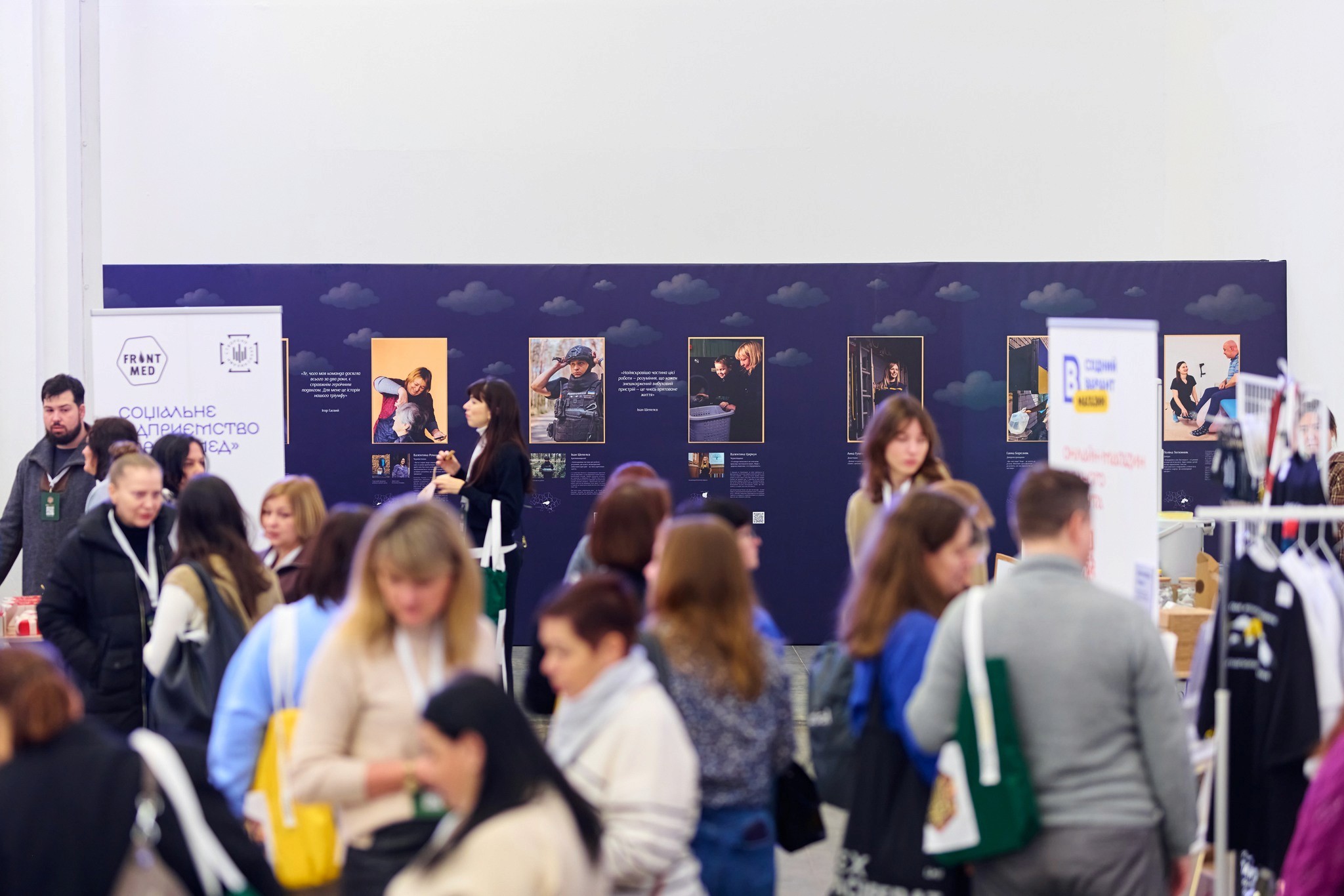
For these reasons we decided to use the colours and cloud motive of The Waking State and similar works of René Magritte to design the exhibition wall. Presenting the portraits of our Ukrainian heroes as the shining windows in the painting.
Part 3: Naming
Naming this exhibition also required precision. The title needed to be connected both to the aesthetic we had established and to the goals of the UNDP and EU programmes that this exhibition was meant to celebrate.
Inspired by the image of a Ukrainian person keeping the lights on in a once-destroyed home, and by the stories of UNDP and EU cooperation that make repairing those homes possible, we named the exhibition The Lights Stay On.
We believe this title worked because, across cultures, a light left on signals presence, warmth, and waiting. Even in the darkest circumstances, it suggests that life continues and that someone is still there.
The title reinforces the pride and hope at the heart of the exhibition, while echoing both the imagery of The Waking State and the perseverance of Ukrainians living through destruction.
Result
Thus, the resulting exhibition wall answered the challenges we laid out earlier. By avoiding compassion fatigue and focusing on pride and connection, it created a cultural bridge between Brussels audiences and Ukrainian realities, allowing the stories to resonate clearly within a busy political environment.
The exhibition was first presented at the European Parliament in Brussels in September 2025, placing the stories at the heart of European democracy. Alongside the physical installation, the digital campaign at Brussels Airport extended the reach of the project significantly, generating 4.7 million impressions.
In December 2025, the exhibition traveled to Ukraine for its national debut at the XIV Civil Society Forum in Kyiv, bringing the narrative back to Ukrainian audiences. Throughout 2026, the project will continue to tour across regions of Ukraine, expanding its reach and maintaining the connection between European support and the communities it helps sustain.
Reviews
Stefan Schleuning, Head of Cooperation at the EU Delegation to Ukraine, emphasized the EU’s commitment to Ukraine’s recovery and development:
“This exhibition is more than photographs; it is a vivid reflection of our partnership and of solidarity in action. Each story shows how our collective efforts translate into real impact on the ground: restoring health care services, supporting local initiatives, and helping communities rebuild. These lights are a beacon of hope and a symbol of our shared vision for a strong, sovereign, and prosperous Ukraine.”
Auke Lootsma, UNDP Resident Representative in Ukraine, highlighted the human spirit behind the exhibition:
“Every photograph here tells a story of resilience — of teachers, medics, volunteers, and community leaders who refuse to give in to darkness. Working hand in hand with the EU, we are committed to empowering communities to build a foundation for a better future. This exhibition honours their efforts and reminds us that true recovery is rooted in people — in their courage and compassion that lights the way forward.”
Intro
The Lights Stay On is a documentary photo exhibition commissioned by United Nations Development Programme (UNDP) and the European Union (EU) to highlight the resilience of the Ukrainian people and the impact of Ukrainian partnership with the EU and UNDP.”
Context
During Russia's full-scale invasion of Ukraine, the UNDP and the EU launched multiple development and recovery programs supporting Ukrainian communities.
The continuation of these development programs mostly depends on continued support from EU policymakers and stakeholders.
For this reason exhibitions and other mediums are often used to foster continued support.
The task
Our foremost task was to foster this continued support by presenting tangible results of the Ukrainian - European partnership, in the form of a documentary style photo exhibition (within the European parliament) presenting the stories of Ukrainian individuals that were most affected by the different UNDP and EU programmes.
Secondarily we were tasked with presenting this exhibition as a digital campaign at Brussels Airport, to maintain support among the European tax payer.
Preliminary research
To understand our goal and challenges more clearly we started our process with interviewing EU officials and diplomatic workers about their exhibition experiences.
Two responses stood out:
“It’s hard to see suffering every day, it creates a feeling of powerlessness — even though we are building support programs constantly.”, - Respondant A
“I understand the importance of documentary evidence, but I wouldn’t bring my children to these exhibitions. Even I find them hard to look at, often I walk away.”, - Respondant B
Showing that similar exhibitions mostly rely on the same strategy: using images of human suffering to provoke empathy, and that this strategy has its downsides.
This repeated exposure to traumatic imagery leads to compassion fatigue — a natural coping mechanism. Instead of mobilising action, such exhibitions risk creating distance, numbness, or avoidance.
Challenge
Having done our research we voiced the following challenges:
EU officials, diplomats, and policy builders are exposed to global tragedies daily. To reach them effectively we cannot rely on provoking empathy from suffering.
Our audience is multicultural, and likely has minimal knowledge about Ukraine or its culture.
Our audience is busy and has limited time and attention.
The exhibition shares space with many competing political and humanitarian narratives and should stand out.
The key question
How do you create a real emotional connection and inspire continued support without overwhelming the viewer and triggering compassion fatigue?
Our Answer
Emotional connection doesn’t only come from pain. Pride, hope, recognition, and connection can be more powerful and more sustainable motivators than shock. Showing what European support already makes possible is more effective than repeating images of loss.
Our Approach
Part 1: Representing Pride through Stories
To invoke the feelings of pride of what was already accomplished, we
curated stories from the UNDP’s extensive interview archive in the following way:
Reviewed all relevant reports and program documentation, to represent the background accurately.
Selected those stories that:
Demonstrated the significant impact of EU-UNDP programs.
Demonstrated the resilience, gratitude and heroism of the Ukrainian hero’s.
Show the human faces that these policies affect.
Edited the report style interviews into short stories that:
Where easy to read and to the point.
Highlighted the incredible results of the programme.
Simplified cultural references.
Simplified geographic references by adding clear infographics showing each hero’s location, helping visitors situate stories spatially within Ukraine
Part 2: Connecting Cultures through Visuals
To strengthen the exhibition's cultural connection, we looked for European symbolism that our audience in Brussels would recognise and feel connected to, using it to help tell the Ukrainian story with an aesthetic they know.
Finding this cultural connection was the most difficult part of this project. So we once again turned to research. While searching for an aspect of European culture that had recently received a lot of attention in Brussels, the celebration of 100 years of Surrealism at the Royal Museum of Fine Arts of Belgium caught our attention.
Knowing that many of our key audience members had visited the celebratory art exhibition, we went in search of a surrealist artwork that could bridge our cultural gap. For this, we invited a group of Ukrainian intellectuals to visit Brussels’ surrealist museums with us in search of a bridging artwork, finding it in the form of The Waking State by René Magritte.
When our guests stated, “this is what it feels like to be Ukrainian,” we were looking at a painting depicting floating windows of a building that no longer exists, while light shines from the windows. Reminding us of a photograph from Borodianka, where Ukrainian children are playing on a playground opposite a destroyed building with a massive hole revealing blue sky and clouds behind it, we knew we had found our bridge.
The Waking State shows the surreal feeling of finding your home in a destroyed building and still deciding to keep the lights on. It embodied the feeling of resilience and hope that we sought for the exhibition's aesthetic. And the fact that it was created by a Belgian artist supported the sense of pride we wanted to be present.
For these reasons we decided to use the colours and cloud motive of The Waking State and similar works of René Magritte to design the exhibition wall. Presenting the portraits of our Ukrainian heroes as the shining windows in the painting.
Part 3: Naming
Naming this exhibition also required precision. The title needed to be connected both to the aesthetic we had established and to the goals of the UNDP and EU programmes that this exhibition was meant to celebrate.
Inspired by the image of a Ukrainian person keeping the lights on in a once-destroyed home, and by the stories of UNDP and EU cooperation that make repairing those homes possible, we named the exhibition The Lights Stay On.
We believe this title worked because, across cultures, a light left on signals presence, warmth, and waiting. Even in the darkest circumstances, it suggests that life continues and that someone is still there.
The title reinforces the pride and hope at the heart of the exhibition, while echoing both the imagery of The Waking State and the perseverance of Ukrainians living through destruction.
Result
Thus, the resulting exhibition wall answered the challenges we laid out earlier. By avoiding compassion fatigue and focusing on pride and connection, it created a cultural bridge between Brussels audiences and Ukrainian realities, allowing the stories to resonate clearly within a busy political environment.
The exhibition was first presented at the European Parliament in Brussels in September 2025, placing the stories at the heart of European democracy. Alongside the physical installation, the digital campaign at Brussels Airport extended the reach of the project significantly, generating 4.7 million impressions.
In December 2025, the exhibition traveled to Ukraine for its national debut at the XIV Civil Society Forum in Kyiv, bringing the narrative back to Ukrainian audiences. Throughout 2026, the project will continue to tour across regions of Ukraine, expanding its reach and maintaining the connection between European support and the communities it helps sustain.
Reviews
Stefan Schleuning, Head of Cooperation at the EU Delegation to Ukraine, emphasized the EU’s commitment to Ukraine’s recovery and development:
“This exhibition is more than photographs; it is a vivid reflection of our partnership and of solidarity in action. Each story shows how our collective efforts translate into real impact on the ground: restoring health care services, supporting local initiatives, and helping communities rebuild. These lights are a beacon of hope and a symbol of our shared vision for a strong, sovereign, and prosperous Ukraine.”
Auke Lootsma, UNDP Resident Representative in Ukraine, highlighted the human spirit behind the exhibition:
“Every photograph here tells a story of resilience — of teachers, medics, volunteers, and community leaders who refuse to give in to darkness. Working hand in hand with the EU, we are committed to empowering communities to build a foundation for a better future. This exhibition honours their efforts and reminds us that true recovery is rooted in people — in their courage and compassion that lights the way forward.”